Picking a fan by looks is how homeowners end up with a noisy, useless fixture that moves air around one chair. The right ceiling fan size for room dimensions depends on square footage, ceiling height, furniture placement, and how much cooling you actually need. I have replaced enough undersized fans in San Antonio living rooms to know the pattern: somebody bought the biggest blade span that fit the budget, then discovered it barely moved air across the sofa.
A fan does not lower the room's temperature like an air conditioner. It moves air across your skin, which helps people feel cooler and can let you raise the thermostat a few degrees. That makes blade span, motor quality, and installation more important than a shiny finish. Start with the room, not the catalog photo.
Match blade span to square footage
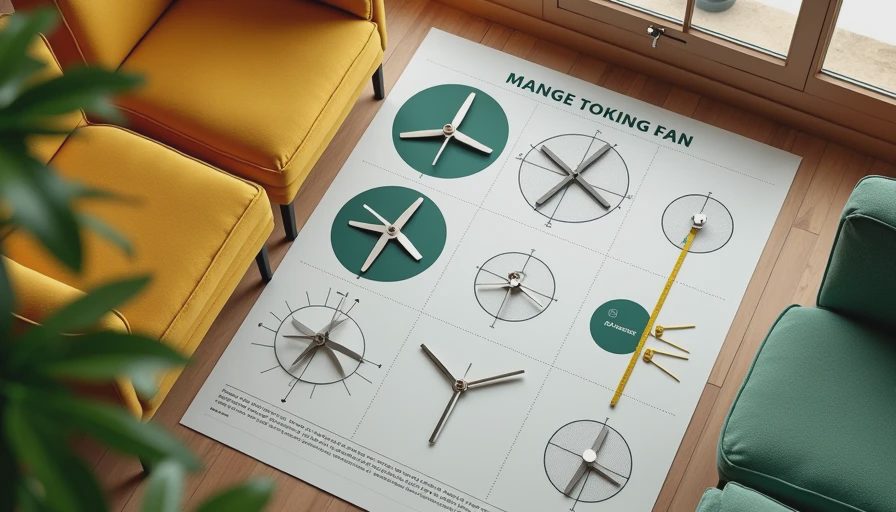
For a room up to about 75 square feet, such as a small office or compact nursery, a fan around 29 to 36 inches usually makes sense. A room from 76 to 144 square feet can generally use a 36- to 42-inch fan. For a 145- to 225-square-foot bedroom or living room, look at 44- to 52-inch models. Rooms larger than 225 square feet often need a 52- to 60-inch fan, or two smaller fans if the space is long and narrow.
Those are starting points, not commandments. A 12-by-15-foot room is 180 square feet, so a 52-inch fan is a reasonable starting point. But if that room opens into a 10-by-12-foot dining area, one fan in the living room may not move air effectively through the whole opening. You may need two fixtures, or one fan positioned over the primary seating zone rather than centered in the combined footprint.
Measure the actual usable area. A large built-in bookcase, fireplace, or wall of cabinets still occupies space, but it also changes airflow. A fan directly over a tall cabinet is wasted money and can create an annoying draft against the wall.

Check ceiling height before ordering
Blade span is only half the ceiling fan size for room decision. The fan also needs proper clearance above the floor and below the ceiling. In a typical eight-foot room, use a low-profile or hugger fan designed for shallow clearance. A standard downrod fan can hang too low, especially in a traffic path, and a person reaching up from a ladder should not be able to touch the blades.
For nine- and ten-foot ceilings, a short downrod usually gives better circulation than mounting the motor tight to the ceiling. With taller ceilings, the fan may need a longer downrod so the blades sit roughly eight to nine feet above the floor. The exact height depends on the fixture, but the basic rule is simple: get the blades into the occupied part of the room without putting them within easy reach.
Never guess at electrical support. A ceiling fan is heavier and creates more movement than a basic light fixture. The electrical box should be fan-rated and securely attached to framing or an approved support brace. I have seen fans installed on ordinary plastic light boxes. They wobble, loosen, and eventually damage the ceiling. Fixing the support before drywall or paint is cheap; repairing a cracked ceiling later is not.
Think about airflow, not just diameter
A wider fan is not automatically better. Look at the motor, blade pitch, speed controls, and airflow rating listed by the manufacturer. Two 52-inch fans can perform very differently. A bargain model with loose blade arms may hum, wobble, and move less air than a well-built 48-inch fan.
For a living room, I prefer a quiet DC-motor model when the budget allows. Brands such as Hunter, Minka-Aire, and Big Ass Fans offer different price levels and styles, but the useful features are the same: stable speed control, reversible direction, balanced blades, and a motor that does not complain at medium speed. Expect roughly $100 to $250 for a basic decent fan and $250 to $700 or more for a quieter, better-controlled fixture.
Use the fan counterclockwise in warm weather so air moves downward. In cooler months, reverse it at low speed to circulate warm air without creating a strong draft. That switch only helps if the fan is installed where people actually sit. A perfectly centered fixture over an empty walkway is not doing much for the family on the sectional.
Place the fan around the furniture layout
The best ceiling fan size for room use is often determined after the furniture plan, not before it. Mark the sofa, chairs, dining table, and walking paths with painter's tape. Then identify the zone where people spend time. In a 16-by-20-foot living room, a 60-inch fan centered in the entire room may sit too far from the sofa if a fireplace and television pull the seating toward one side.
Keep the fan away from walls, tall cabinets, and light fixtures that can interfere with the blades. A nearby chandelier can create a strobing effect as the blades pass in front of its light. Recessed lights usually work better, but their placement still matters. If the fan is going into an existing room, turn off power, inspect the electrical box, and confirm the new fixture will not collide with a smoke detector, sprinkler head, or door swing.
In a long great room, two 44- or 52-inch fans can distribute air more evenly than one oversized fan. They also let you run the occupied side without powering the empty side. That costs more upfront, but it is usually a better solution than trying to force one fan to cover 400 square feet.
Avoid the mistakes I see on renovation jobs
The first mistake is choosing a fan based on the room's ceiling light box. The existing box tells you where the wiring is, not what size fan belongs there. The second is buying a hugger fan for a tall ceiling because the product looked sleek online. Those fans can sit too high to circulate air properly.
Another problem is ignoring the blade sweep around doors and bunk beds. In a bedroom, measure from the blade tips to upper cabinets, closet doors, and the top bunk. Leave practical clearance around walls rather than squeezing a large fan into a tight corner. If a fan has to fit within a narrow opening, a smaller model with a stronger motor can be safer and quieter than an oversized model with barely any room to breathe.
Do not assume a remote control solves a bad installation. A remote cannot balance bent blades, reinforce a weak electrical box, or stop a downrod from shaking. If the fixture wobbles on the first day, shut it off and correct the balance and mounting instead of accepting the noise.
A straightforward buying and installation plan
First, measure the room's length and width, then calculate square footage. Second, measure ceiling height and identify whether a flush-mount, standard downrod, or longer downrod is appropriate. Third, draw the furniture layout and mark the main seating zone. Fourth, check the electrical box for fan-rated support before ordering the fixture.
Next, compare blade span, airflow, motor type, noise reviews, light quality, and warranty. Do not pay extra for a decorative cage or remote feature while ignoring the motor. If the fan includes a light, look for a replaceable LED module or standard bulbs rather than a sealed component that requires replacing the whole fixture later.
For installation, budget about $150 to $350 for a professional electrician or experienced installer in many markets, with more for new wiring, vaulted ceilings, or a support brace. In a renovation, install the brace and box before painting the ceiling. That order prevents patched drywall, fingerprints, and a second service call.
The right ceiling fan size for room conditions should disappear into daily life: steady air, no wobble, no hum, and no one ducking under the blades. Measure first, plan around the people using the room, and spend the money on support and motor quality before paying for decorative extras.



No comments yet — be the first to share a thought.