If you are asking how much does it cost to renovate a living room, you are probably looking at more than paint and a new sofa. A living room renovation can mean repairing a soft floor, moving outlets, replacing drywall, improving lighting, changing flooring, and buying furniture that actually fits through the door. In San Antonio, I usually see a practical renovation land between $8,000 and $25,000. A basic refresh can come in under $5,000, while a full gut job with structural repairs can pass $40,000 quickly.
The number depends on what is behind the walls and under the floor. Start with the bones, not the throw pillows. A room with bad wiring, uneven framing, or a damaged subfloor will punish you for spending money on finishes first.
A realistic living room renovation budget
For a 200- to 300-square-foot living room, labor and materials commonly break down this way. Interior painting runs about $700 to $2,000, depending on wall repairs, ceiling height, trim, and the number of coats. New carpet may cost $1,500 to $3,500 installed. Luxury vinyl plank often runs $2,500 to $6,000, while hardwood refinishing can fall between $3,000 and $7,000.
Drywall repair is usually $500 to $2,500 unless the room needs complete replacement. Recessed lighting, new switches, and added outlets can run $1,500 to $5,000. A fireplace update might cost $2,000 for a simple surround or $8,000 and more when gas, electrical, masonry, or framing work gets involved. Built-in shelves commonly start near $3,000 and climb past $10,000 with custom cabinets and paint-grade trim.
Furniture is a separate budget. A usable sofa from brands such as Room & Board, Article, or La-Z-Boy can cost $1,200 to $4,000. Add a chair, rug, coffee table, lamps, and window coverings, and another $2,000 to $7,000 disappears without anything extravagant. That is why how much does it cost to renovate a living room cannot be answered with a single square-foot price.

What actually drives the price
The biggest cost driver is the order of operations. If the floor slopes because a joist or subfloor is damaged, that gets fixed before flooring. If the walls are wavy, drywall shimming and finishing happen before paint. If you want new ceiling lights, the electrician works before the ceiling is closed and painted. Skipping those steps does not save money; it creates demolition later.
Older San Antonio homes often bring surprises. I have opened walls and found undersized electrical wiring, loose junction boxes, and framing that was never straight to begin with. A 1960s ranch may need more patching than a newer home, even when the room looks fine from the couch. Keep a contingency of 15% to 20%. On a $15,000 project, that means holding back $2,250 to $3,000 for problems you could not see during the first walkthrough.
Layout also affects the price. Moving a television wall may require new outlets, cable routing, blocking for a wall mount, and a different furniture plan. Moving a doorway can involve framing, drywall, trim, flooring, and sometimes electrical work. A cheap-looking layout change can become a $4,000 project before the first coat of paint.
Where homeowners waste renovation money
The first common mistake is buying furniture before measuring the room and the path into it. I once watched a homeowner order a large sectional that fit the floor plan but could not make the turn at the stair landing. The return freight cost more than the delivery. Measure the front door, hallway, stair width, ceiling height, and every tight corner before ordering.
The second mistake is choosing flooring by sample alone. A pale, textured floor can show every crumb and scuff in a busy household. Glossy dark flooring shows dust and footprints. For many families, a mid-tone luxury vinyl plank or a properly finished oak floor is easier to live with than the most dramatic sample in the showroom. Spend money on a stable installation and a good transition detail. Those are what you see every day.
The third mistake is hiring the cheapest drywall finisher. Poor seams show under recessed lights and across large walls. Fixing bad finishing after paint can cost $1,000 to $3,000, and you still lose time. Get a written scope that says who protects the floor, repairs nail pops, sands the surface, primes repairs, and cleans up.

A better order of operations
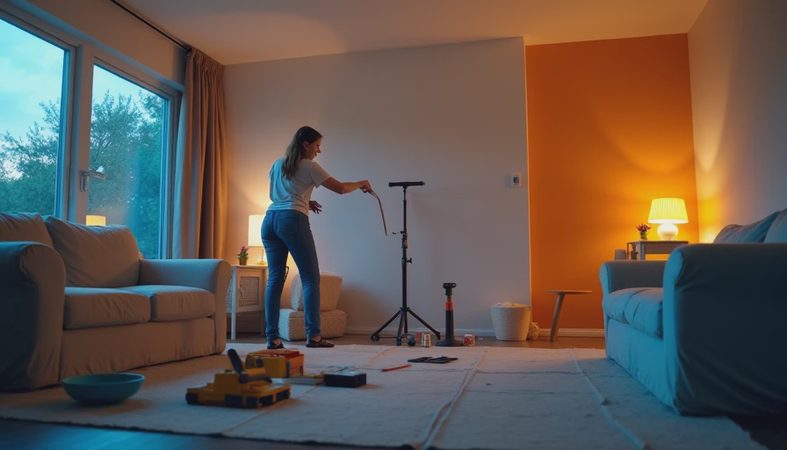
First, empty the room and inspect the floor, walls, ceiling, windows, outlets, vents, and door swing. Take photographs before removing anything. Second, decide what must move: electrical, lighting, HVAC vents, television wiring, and built-ins. Third, get contractor pricing from the same written scope so you are comparing the same job rather than three different guesses.
After demolition, the electrician and any framing crew work first. Then repair or replace the subfloor, close the walls, and complete drywall finishing. Flooring generally follows heavy wall work, although some contractors install floors earlier and protect them carefully. After flooring comes baseboard and casing, then primer and paint. Install lights, hardware, window coverings, and built-ins near the end. Furniture is last.
This sequence answers how much does it cost to renovate a living room more honestly than an online calculator. The price is tied to the number of trades involved and the number of times the same surface has to be touched. A room that needs one painter is cheap. A room that needs a framer, electrician, drywall finisher, flooring installer, trim carpenter, and painter is not.
How to control the budget without making the room cheap
Keep the existing layout if the traffic pattern works. Moving walls and doors is expensive; changing paint, lighting, flooring, and furniture is more controllable. Use standard-size windows, doors, and cabinets when possible. Custom dimensions create custom labor charges.
Spend first on safety, structure, and daily comfort. Repair loose floors, correct unsafe wiring, improve task and ambient lighting, and address drafts or poor airflow. A $2,500 electrical upgrade can be more valuable than a $6,000 stone feature wall. Likewise, a well-built sofa with replaceable cushions usually serves you better than a trendy piece with weak suspension.
When comparing estimates, ask whether disposal, permits, primer, floor protection, trim painting, and final cleanup are included. Ask what happens if the contractor finds water damage or asbestos-containing material in an older home. Do not approve a vague allowance for “miscellaneous repairs.” That phrase is where budgets go to hide.
So, what should you plan to spend?
For a cosmetic refresh, plan on $3,000 to $8,000. That usually covers paint, minor drywall repair, lighting swaps, window treatments, and selected furniture. For a medium renovation with new flooring, electrical changes, trim, and better furniture, $10,000 to $25,000 is a realistic working range in the San Antonio market. A full renovation involving wall changes, extensive wiring, built-ins, fireplace work, or structural repairs can run $25,000 to $45,000 or more.
The useful answer to how much does it cost to renovate a living room is the amount required for your actual scope, not someone else's photo. Before you shop for a sofa, walk the room with a tape measure and a flashlight. Find the problem under the floor, behind the wall, and above the ceiling. Then price the work in the right order, keep a contingency, and get a detailed proposal. That is how you finish with a room that works instead of a beautiful bill for a room that still annoys you.

No comments yet — be the first to share a thought.