An area rug is the one thing in a living room that takes every footstep, every spill, every furniture leg, and every toy that gets dropped on it, and it's supposed to look good while doing it. That's a big ask for a piece of fabric you put on the floor. And yet most people pick a rug based on two things: color and whether it's on sale.
I've seen $2,000 wool rugs destroyed by a puppy in six weeks. I've seen cheap polypropylene rugs outlast sofas. I've walked into living rooms where the rug looked like a bath mat because it was three sizes too small for the seating group. The rug is the anchor of your layout — the thing that defines the zone — and if it's the wrong size or the wrong material, the whole room feels off. Here's how to buy the right one.
The Sizing Rule That 90% of People Get Wrong
All Front Legs on the Rug, or All Four — No Half Measures
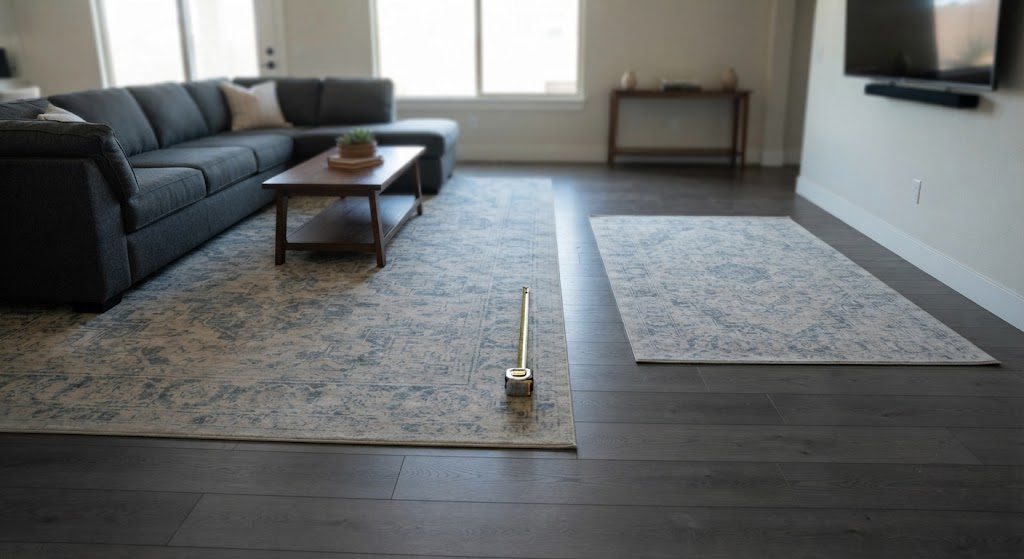
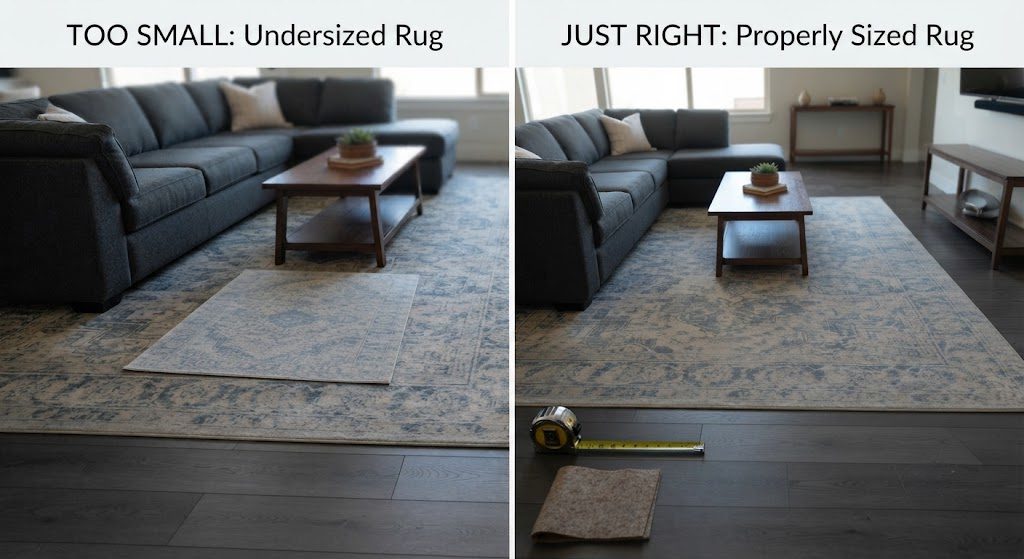
The most common rug mistake I see on job walks is a rug that's too small. It floats in the middle of the seating group with the sofa and chairs completely off the edges. The rug marks nothing. It's a decorative bath mat in the center of the room.
The rule is simple: at minimum, the front legs of every seating piece sit on the rug. Sofa, loveseat, accent chairs — front two legs on the rug. That connects the pieces visually and makes the seating group read as one zone. If you've got the space and the budget, go bigger and put all four legs of every piece on the rug. That's the full-anchor look, and it's what I did in my own living room.
The Numbers: Start at 8x10
For most living rooms, an 8x10 rug is the minimum starting point. In a larger room with a full-size sofa and two chairs, a 9x12 is better. I measure the seating footprint first — the rectangle that contains all the furniture — then add 12 to 18 inches on each side. That gives you the rug size. If your seating footprint is 8 feet by 10 feet, you need a 9x12 at minimum, not an 8x10. The rug should extend beyond the furniture, not shrink underneath it.
I keep a running list in my head: 5x7 is for a small office or a bedroom side. 6x9 is for a compact apartment setup. 8x10 is the living room starting line. 9x12 is where most rooms actually look right.
Material Breakdown: Wool, Polypropylene, and the Blends
Wool: The Gold Standard With a Catch
Wool rugs feel good underfoot, wear slowly, and clean up better than you'd expect because wool has natural stain resistance. A good hand-knotted wool rug can last decades. But wool sheds for the first year, and it's not great in high-moisture situations. If your living room opens to a patio and wet feet are a regular thing, wool will hold onto that dampness. It's also expensive — a quality 8x10 wool rug starts around $800 and goes up fast.
Polypropylene: The Workhorse That Doesn't Pretend
Polypropylene — also called olefin — is synthetic, stain-resistant, and cheap. It doesn't shed, it can be hosed off if things get really bad, and it handles moisture without growing mold. The trade-off: it feels less luxurious underfoot, and cheap polypropylene can look plasticky in direct sunlight. For a living room with kids and pets, it's the most practical option on the market. I've recommended polypropylene rugs to more families than I can count, and nobody's called me back to complain.
Cotton and Viscose: Skip Them for Living Rooms
Cotton rugs are washable, which is nice, but they wear thin fast in high-traffic areas. Viscose looks like silk and costs like polyester, but it's fragile — it yellows in sun, can't handle moisture, and crushes under furniture legs. I've seen viscose rugs ruined by a single spilled glass of water. These belong in a bedroom or a low-traffic sitting room, not the main living area.
Pile Height: Low Is Your Friend
In a living room, low-pile and flatweave rugs win. High-pile shag rugs trap crumbs, show vacuum tracks, and make furniture legs sit unevenly. They also make it harder to slide a chair back or push a coffee table out of the way. If you like a softer feel, get a medium-pile wool rug with a dense weave and call it a compromise. Anything deeper than half an inch is going to fight you in a room where people actually move around.
The Rug Pad: Don't Skip It
A rug without a pad slides, wrinkles, and wears out faster because the backing rubs against the hard floor underneath. A good felt-and-rubber pad adds cushion, stops slipping, and extends the life of the rug by years. I buy pads that are slightly smaller than the rug — trim it back about an inch from the edge so it doesn't peek out. On a concrete slab, which is common in Texas, a thicker pad also adds insulation. Worth every dollar.
What's Under My Feet at Home
I've got a 9x12 polypropylene rug with a low pile and a felt-and-rubber pad under it. It's been through two kids, a dog, a Super Bowl party where someone dropped an entire plate of queso, and three years of LEGO construction. Still looks fine. Cost me around $350. I'm not saying it's the fanciest rug in San Antonio. I'm saying it's the one that survived.
No comments yet — be the first to share a thought.