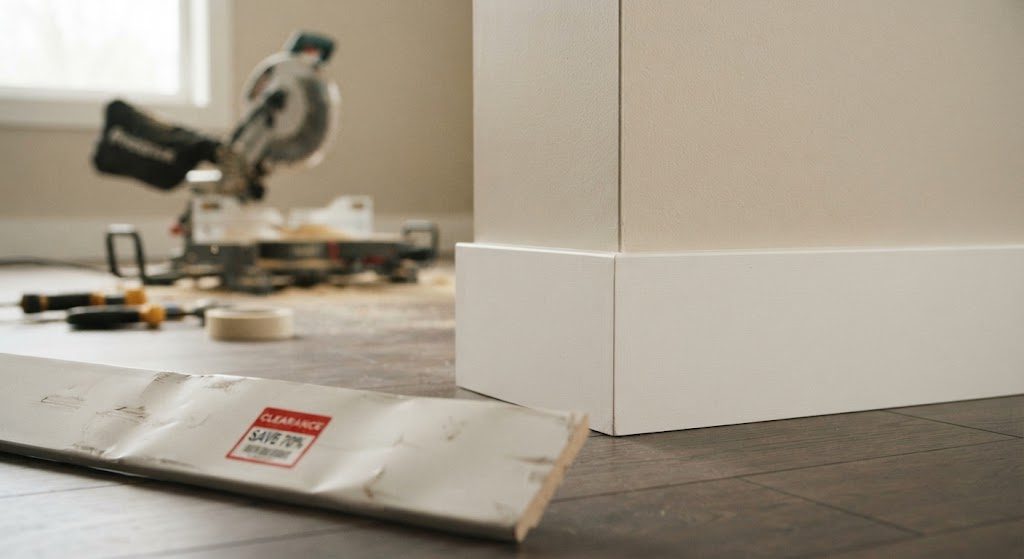
I can walk into a living room and tell you within ten seconds whether the trim budget got cut. The baseboard is too short for the ceiling height, the door casing is a flimsy two-and-a-quarter-inch profile that looks like it came with the house, and the inside corners are opening up because someone didn't know how to cope a joint. The paint is fresh, the floor is new, and the trim makes the whole room feel cheap. It's the last thing that gets installed and the first thing everyone sees.
Trim gets cut from the budget because it doesn't feel urgent. You've already spent money on flooring, drywall, paint, and maybe a new sofa. Baseboards feel like an afterthought — something you can do later, or do cheap, or skip altogether. But trim is what finishes a room. It's the frame on the painting. Do it wrong, and every other choice looks worse.
Baseboard Height: The Number That Scales the Room
Ceiling Height Determines Baseboard Size
There's a simple ratio I use on every job: baseboard height should be roughly 5% to 7% of the wall height. An 8-foot ceiling — 96 inches — calls for baseboard between 5 and 7 inches tall. A 9-foot ceiling pushes that to 6 or 8 inches. In rooms with 10-foot ceilings, you need 7 to 9 inches, minimum, or the baseboard disappears visually and the room looks bottom-heavy.
I walk into living rooms with 9-foot ceilings and 3-inch baseboard all the time. It looks like the builder ran out of material and called it good. Taller baseboard costs more per linear foot, but it's one of the cheapest ways to make a room feel more substantial. The material difference between a 3-inch MDF base and a 7-inch finger-jointed pine base is maybe two dollars a foot. Across an average living room, that's $150 difference. Money well spent.
Crown Molding: Do It or Don't, But Don't Half-Do It
Crown molding adds a finished look, but it's not mandatory. A clean, square drywall corner at the ceiling can look modern and intentional if the paint line is crisp. What looks terrible is cheap, small-profile crown — the two-and-a-half-inch stuff from the home center — installed in a room where nothing else matches the scale. If you're doing crown, commit to a profile sized to the room and pay someone who knows how to cut and cope inside corners. A gap-filled, caulked-to-death crown joint catches light and shadow every time the sun moves.
Material Matters: MDF vs. Pine vs. Finger-Jointed
The Cheap Stuff Costs More in Labor Than It Saves in Material
I see homeowners buy primed MDF baseboard from the big-box store because it's cheap — $1.50 a linear foot versus $3 or $4 for finger-jointed pine. Then the installer spends extra hours fighting warped boards, filling dented edges, and trying to get miters to close on a material that crushes under a pin nailer if you look at it wrong. MDF dents when a vacuum hits it. It swells if the floor gets wet. It doesn't hold a crisp edge over time.
Finger-jointed pine — sometimes sold as "paint-grade" — costs more up front but installs faster, holds fasteners better, and doesn't swell at the joints when the humidity swings. For painted trim in a living room, it's the floor I recommend. If you're staining the trim, you'll need clear-grade or select-grade, which is a different price bracket entirely.
Door and Window Casing: Match the Era, Not the Trend
Your door and window casing should match the house. A 1990s suburban home looks right with 3-inch or 4-inch flat-stock casing. An older craftsman-style house might call for a built-up head with a backband and a thicker profile. Don't put modern ultra-thin casing in a traditional house or heavy colonial casing in a minimalist box. Trim tells the house's story. Keep it consistent.
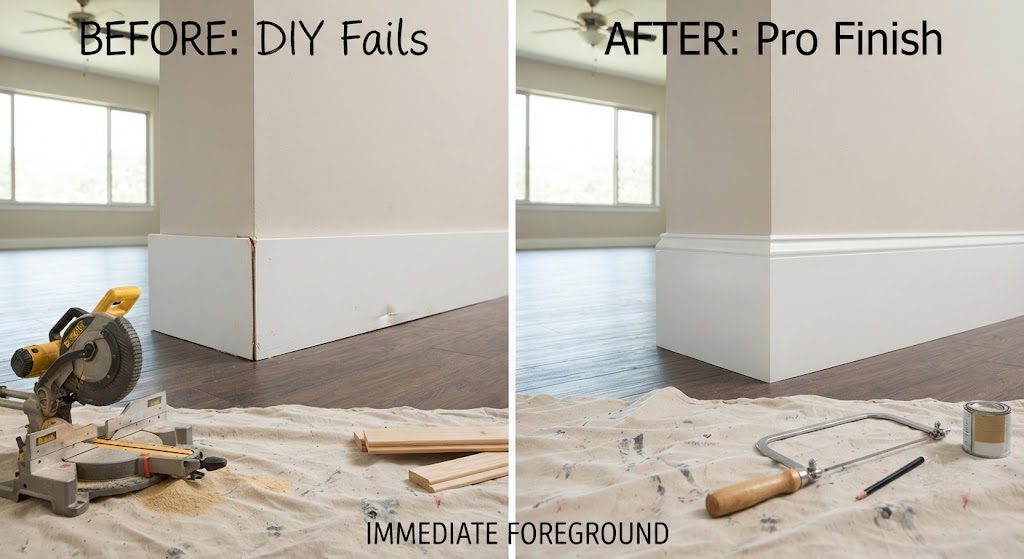
Installation: Coping, Mitering, and the Joints That Separate
Inside corners need to be coped, not just mitered. A mitered inside corner opens up with seasonal movement and leaves a dark V-shaped gap. A coped joint — where one piece is cut to follow the profile of the other — stays tight year-round. It takes more skill, but it's the standard for a reason. Outside corners should be glued and nailed, not just nailed. Wood glue on a miter prevents that hairline crack from showing up six months after the painter leaves.
What I Put in My Own Living Room
I ran 7-inch finger-jointed pine baseboard, 4-inch flat-stock door casing, and skipped the crown — my ceilings are 8 feet and I wanted a clean, modern line. Material cost for the whole room was around $300. A trim carpenter I trust installed it in a day and a half, and the miters are still tight three years later. Nobody walks in and says "nice baseboards." That's exactly the point — they don't notice it. They just feel like the room is finished.


No comments yet — be the first to share a thought.