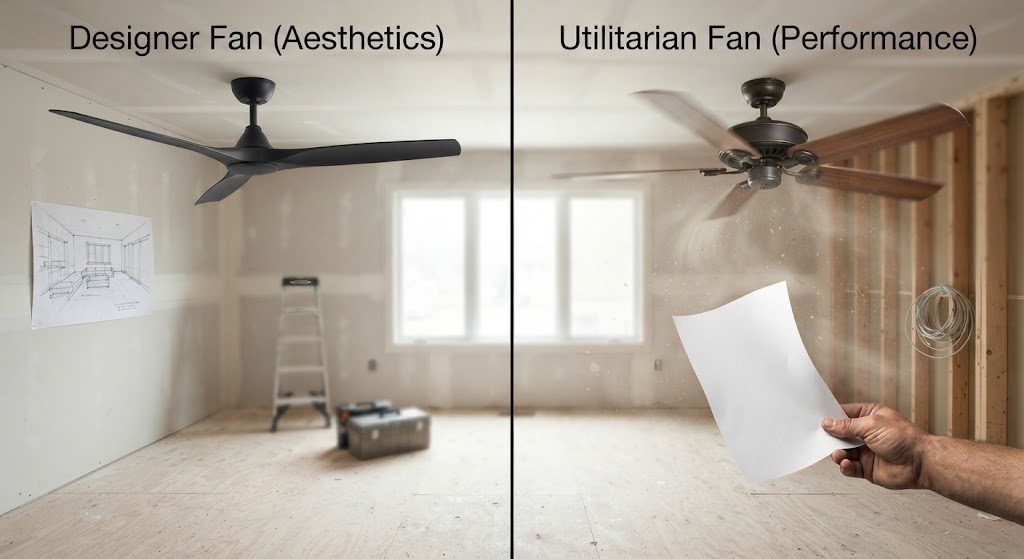
Ceiling fans are one of the few things in a living room that earn their keep every single day. In a Texas summer, a good ceiling fan can make a room feel five degrees cooler without touching the thermostat. In the winter, you flip the switch and it pushes warm air down from the ceiling. That’s real value — or at least it is when the fan actually works.
I’ve hung ceiling fans in living rooms that cost forty dollars and in living rooms that cost four hundred. The price tag doesn’t tell you much. What tells you everything is whether the fan moves air or just spins quietly while everyone sweats on the sofa. Here’s how to know the difference before you buy.
The Three Numbers That Actually Matter
CFM: Cubic Feet Per Minute
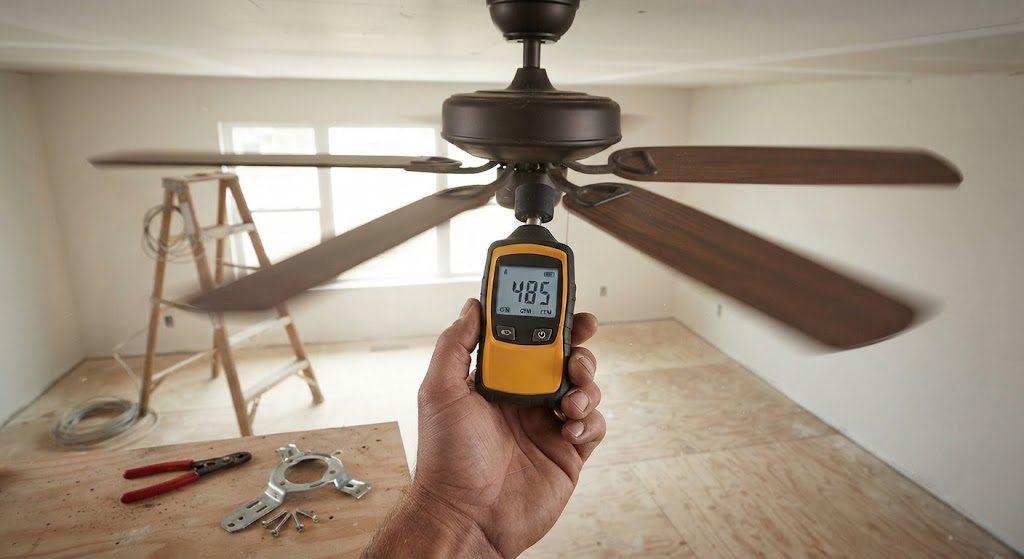
This is the only number that tells you how much air the fan moves. CFM measures airflow — higher is better. A decent living room fan should push at least 5,000 CFM on high speed. A great one pushes 6,000 to 7,000 or more. If the box doesn’t list CFM, put it back on the shelf. The manufacturer is hiding something, and it’s probably that the fan is all looks and no breeze.
The federal Energy Star standard for a medium-sized room fan is around 5,000 CFM at high speed. Don’t settle for less.
Blade Pitch
Blade pitch is the angle of the blades relative to the horizontal. It’s measured in degrees. 12 to 15 degrees is the sweet spot. Anything flatter than 10 degrees is just stirring the air, not moving it. I’ve pulled down fans with blades so flat they could have been kitchen spatulas — 8 degrees, maybe 9. The homeowner thought they were quiet. They were quiet because they weren’t doing anything.
Don’t confuse blade pitch with blade count. A three-blade fan with a steep pitch will outperform a five-blade fan with flat blades every time.
Motor Type
You’ve got two options: AC motors and DC motors. AC is the standard — reliable, cheap to manufacture, and what’s in most fans under two hundred dollars. A good AC motor with a heavy copper winding will run cool and last years. A cheap AC motor with a thin winding will hum, wobble, and burn out.
DC motors are more efficient, quieter, and usually come with more speed settings, including very low ones that AC motors can’t hit smoothly. They cost more upfront. I’ve installed DC-motor fans from brands like Modern Fan and Fanimation that are dead silent at every speed. If your living room ceiling is high and you want consistent airflow without hearing the motor, DC is worth the extra money.
What I Look for When I Open the Box
Before I even mount the bracket, I can tell you whether a fan is going to wobble. Hold the blades. Are they warped? Cheap pressed-wood blades with a thin veneer will warp in a humid room within a year. I look for ABS plastic blades — they don’t absorb moisture and they hold their shape. Some composite wood blades are good too, if they’re sealed well.
Check the mounting system. A fan that hangs from a ball-and-socket bracket on a sloped ceiling needs a solid canopy and a heavy downrod. If the bracket is stamped steel that flexes in your hand, the fan will wobble no matter how well you balance it.
The Fan I Installed in My Own Living Room
I’ve got a 52-inch DC-motor fan with ABS blades and a 14-degree blade pitch. It moves just under 6,500 CFM on high, which is enough to feel in every corner of the room. On low, it’s silent. I paid around three hundred dollars for it four years ago. It’s still balanced, still quiet, and still moving air like the day I hung it.
A ceiling fan is not a light fixture. It’s a tool. Buy it like one.



No comments yet — be the first to share a thought.