I've stood in more living rooms than I can count where the entire layout was held hostage by one wall. The wall has a fireplace in the middle — sometimes a beautiful brick hearth, sometimes a 1990s gas unit with brass trim that hasn't been updated since the Clinton administration. And the homeowner wants to know where to put the television, because every other wall is either a window, an open doorway, or too small for a sofa.
The fireplace wall is the room's natural focal point. The mantel is already there, the hearth is already drawing the eye, and the builders put the cable jack on that wall for a reason. But putting the TV above a working fireplace is almost always the wrong answer. Here's why — and here's what to do instead.
Why Above the Fireplace Usually Fails
Heat Destroys Electronics
A fireplace that actually produces heat — wood-burning or gas — sends a column of hot air straight up the face of the wall. Your television's operating temperature tops out around 100 to 105 degrees Fahrenheit depending on the model. I've measured mantel surfaces at 130 degrees and higher during a full fire. Even if the TV doesn't shut down from thermal overload, running it hot shortens its life. Manufacturers put the heat warnings in the manual for a reason.
Neck Strain Is Real
The optimal TV viewing height puts the center of the screen at roughly eye level when seated — 42 to 48 inches from the floor. A standard mantel sits at 54 to 60 inches. Mount a TV above that, and the bottom edge of the screen starts around five feet up. The center is closer to 65 inches. That's a 15- to 20-degree upward viewing angle from a seated position, sustained for two hours during a movie. Your neck will tell you about it by the second act.
If the fireplace is purely decorative — never used, never will be — then mounting above it with a pull-down mantel mount that drops the screen to eye level is a workable option. But if you burn wood or run the gas logs, let's look at the alternatives.
Solution One: The Adjacent Wall, Perpendicular to the Fireplace
The Ninety-Degree Layout
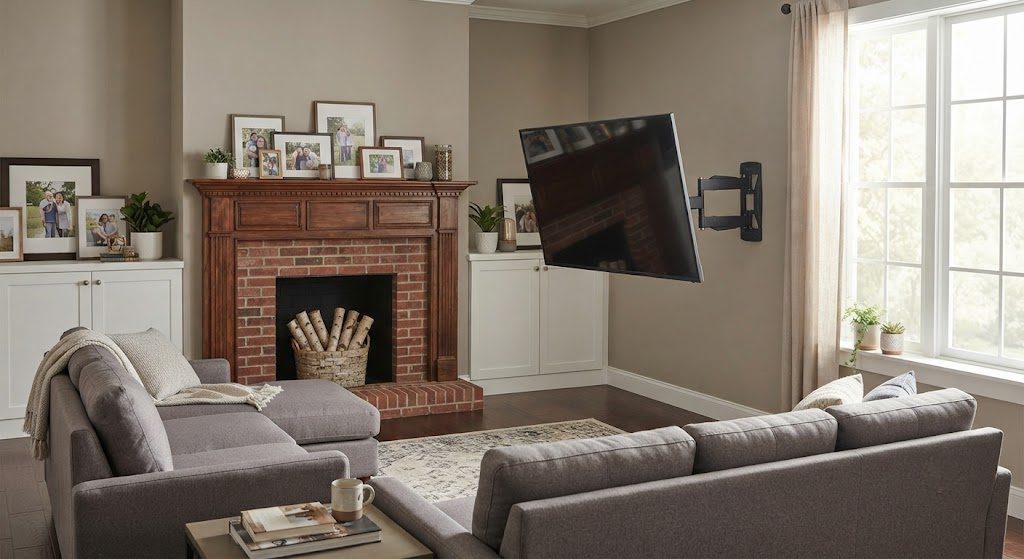
This is the setup I use most often when the room allows it. The fireplace stays on its wall, unblocked. The TV goes on a perpendicular wall to the left or right. The sofa is placed across from the TV, angled slightly if needed, but primarily facing the screen. The fireplace becomes a secondary feature — still visible from the seating, still usable, but not fighting the TV for head-on attention.
An L-shaped sectional works perfectly here. The long side faces the TV. The short return runs along the wall opposite the fireplace, or under a window. You get good viewing angles for the screen and a clear sightline to the fire. Nobody has to choose between warmth and the game.
The catch: this layout needs a room that's wide enough, or at least shaped right. If the fireplace is centered on the long wall in a narrow rectangular room, the perpendicular wall may be too close or too far for comfortable TV viewing. Measure before you commit.
The Articulating Arm Mount
If the perpendicular wall is the right distance but the TV needs to angle toward the sofa, I use a full-motion articulating mount. It pulls out from the wall, swivels toward the seating, and pushes back flat when not in use. This is the solution I see in about a third of the living rooms I work on. It's not the cleanest look when pulled out — the TV floats in space — but it works, and it keeps the screen at a healthy viewing angle.
Solution Two: Same Wall, Side-by-Side, With Intentional Balance
Treat Both as a Single Composition
If the fireplace wall is wide enough and the TV can't go anywhere else, put them side by side at the same height. The fireplace stays centered or offset. The TV goes next to it, mounted at seating eye level — 42 to 48 inches center — in its own zone. A long, low media console underneath both ties them together visually. The console runs the length of the wall, with the fireplace rising from one section and the TV floating above another.
This works best in rooms where the fireplace is off-center to begin with, or where a wide wall gives you room for both without crowding. It doesn't work on a narrow wall with a centered fireplace and no flanking space. But when it works, it's the cleanest solution — no neck strain, no heat damage, and both features get their due.
The key is balance. If the fireplace is tall and vertical, the TV needs to be sized and positioned so the whole wall reads as one composed unit, not two random rectangles fighting for attention. A matching set of built-ins or floating shelves on either side can help unify the composition.
Solution Three: Abandon the Wall Altogether
Make the Fireplace a Side Feature
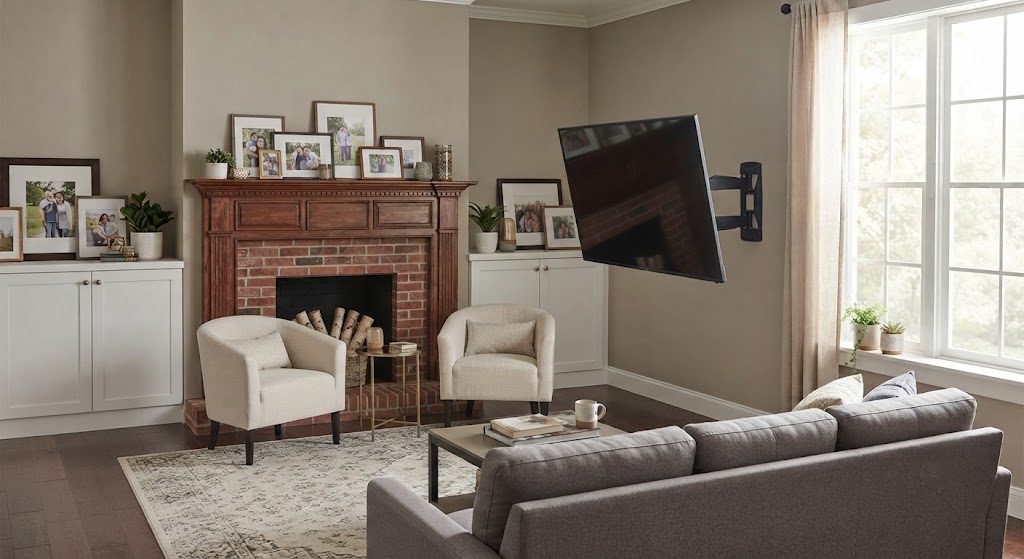
Sometimes the right answer is to stop treating the fireplace wall as the main wall. Float the sofa in the center of the room, facing the opposite wall. Put the TV there, at the correct height, with the sofa at the correct distance. The fireplace lives on its own wall, with a pair of chairs or a reading nook oriented toward it. The room gains two functional zones instead of one compromised one.
I've spec'd this layout in living rooms where the fireplace wall was awkwardly placed — too close to a doorway, or on a wall that made the furniture arrangement impossible. It takes courage to demote the fireplace from focal point to side feature, but if the room works better that way, do it. The fireplace will still keep you warm. It doesn't need to run the whole layout.
What I've Done When the Client Insists
I've had clients who absolutely, non-negotiably wanted the TV above the fireplace. In those cases, I spec three things: a heat-deflecting mantel hood or a recessed TV nook with proper ventilation clearance, a pull-down mount that drops the screen to eye level, and an electric fireplace insert that doesn't produce real heat above the unit. If you're going to break the rules, at least mitigate the damage.
But if you're starting from scratch, pick one of the three solutions above. Your neck will thank you, your TV will last longer, and your living room won't feel like a compromise.
No comments yet — be the first to share a thought.