Every client I've had in the last five years has shown me a photo of a living room with floor-to-ceiling built-in bookcases flanking a fireplace or a TV. It's one of the most pinned images on the internet. And I get it — built-ins look permanent, intentional, and expensive in a good way. What the photos never show is the wall behind those shelves, the floor underneath them, or the invoice at the end of the job.
Freestanding storage — bookshelves, media consoles, sideboards — costs less, moves with you, and doesn't require a carpenter. But it also doesn't solve the specific storage problems that built-ins are designed to solve. The choice between the two isn't a design debate. It's a construction math problem. Here's how I help clients solve it.
The First Question I Ask Every Client
Are You Staying or Going?
If you're going to be in this house for less than five years, don't build custom casework into the walls. You won't recoup the cost in resale value, and the next owner might not want your specific configuration. A good freestanding media console and a pair of matching bookshelves will serve the room just fine and can leave with you.
If this is your long-term house — the one you're gutting room by room, the one where you've already fixed the subfloor and replaced the windows — then built-ins start to make sense. They're an investment in how you actually use the space, and you'll live with the benefit long enough to justify the cost.
What Built-Ins Actually Cost in San Antonio
Real Numbers, Not Showroom Estimates
A basic built-in unit — two lower cabinets, open shelving above, a center cutout for a TV, paint-grade poplar or birch plywood, no exotic hardware — starts around $3,500 to $5,000 for a single wall in the San Antonio market. That's for a finish carpenter who knows what he's doing, not a handyman with a pocket-hole jig.
If you want hardwood face frames, soft-close hinges, integrated lighting, or a desk built into the configuration, the number climbs fast. I've done full-wall built-ins that hit $12,000 by the time the painter and electrician finished. That's real cabinetry, real joinery, and real labor. It's also a number that makes a lot of people look at the freestanding furniture aisle with fresh appreciation.
On the other side, a good-quality media console and two matching bookcases from a reputable manufacturer — not the particle-board special from a big-box store — will run you $1,500 to $3,000 total. That's a third to half the cost of entry-level built-ins, and zero installation labor.
When the Wall Makes the Decision for You
Wiring, Vents, and Foundation Movement
Built-ins require a flat, level wall and a stable floor. If your living room has a slab foundation that moves with the seasons — common in Texas clay soil — a built-in that's fastened to both the wall and the floor can develop cracks at the seams within a year or two. I've had to float built-in units on adjustable bases and attach them only to the wall, leaving a gap at the bottom concealed by trim. That adds cost and complexity.
If the wall you want to build into has electrical outlets, light switches, or an HVAC return, those need to be relocated — or the built-in design needs to work around them. Moving a single outlet is a $200 electrician visit. Moving a return-air grille is an HVAC contractor and several hundred dollars more. Freestanding furniture just sits in front of these things and leaves them accessible.
The Stud Layout You Can't See
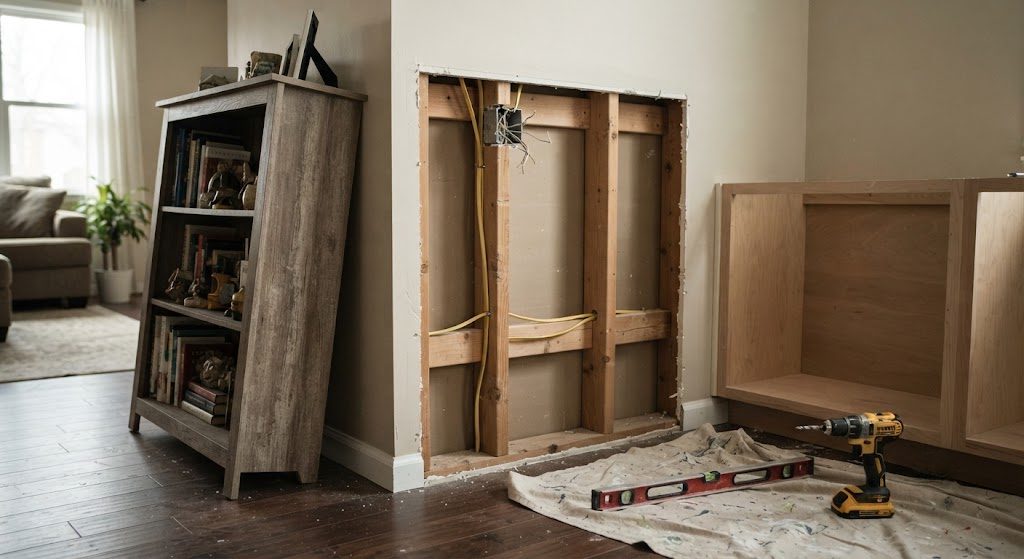
Before you plan any built-in, open up a small section of drywall or use a good stud finder to map what's behind the surface. If the wall is load-bearing with studs at 16 inches on center and no plumbing or ductwork running through it, you're in good shape. If it's an interior wall with 24-inch stud spacing, you'll need blocking for the cabinets to attach to. If it's an exterior wall in an older home with no insulation and you plan to fill the cavity after demo, that's another line item.
Where Built-Ins Actually Win
Awkward Spaces and Dead Zones
There are places where freestanding furniture simply can't do the job. A shallow alcove next to a fireplace. A wall with a knee-wall bump-out that standard bookcases can't fit. A room where the TV needs to be recessed because the viewing distance is tight and a console would stick out too far. These are the scenarios where built-ins earn their cost. They turn a useless dead zone into functional storage and make the room feel like someone planned it on purpose.
I did a job in a 1960s ranch where the living room had a 14-inch-deep niche next to the chimney chase — too shallow for any standard bookshelf, too deep to ignore. We built a custom unit with 12-inch-deep shelving, flush to the surrounding wall. It cost around $2,800 and transformed the entire room. A freestanding unit would have sat six inches proud of the wall and looked like a mistake. That's the case for built-ins in one sentence: when the alternative looks like a mistake.
The Hybrid Approach I Use Most Often
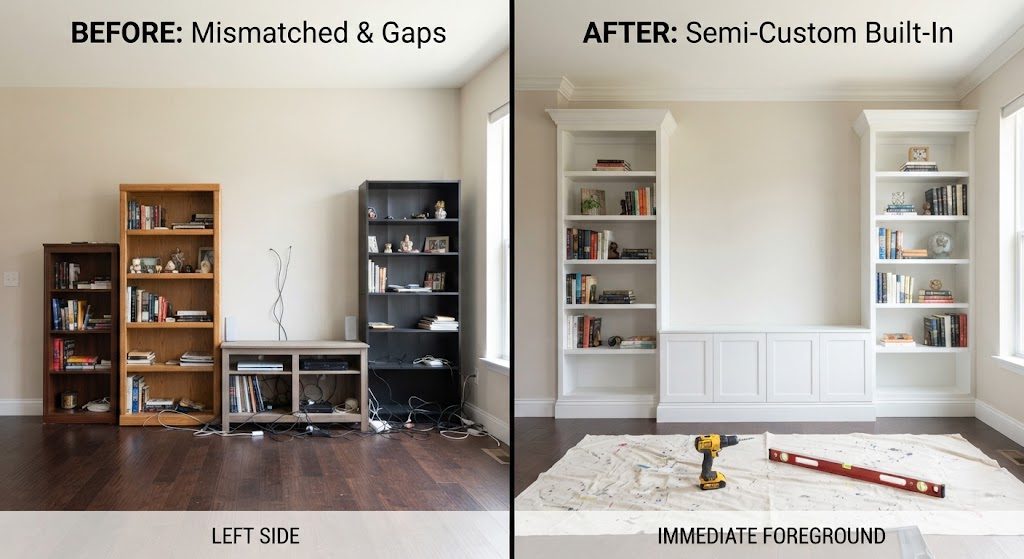
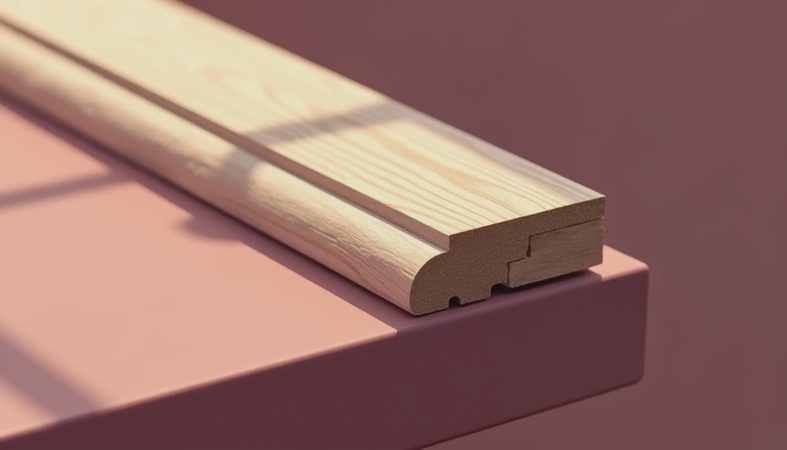
In my own living room, I went with a hybrid — a freestanding media console in the center, with two floor-to-ceiling bookcases anchored to the wall on either side. The bookcases aren't true built-ins — they're semi-custom units designed to look like built-ins, with trim pieces added at the top and base to close the gaps. Total cost was around $2,200 for materials and a day of installation. It gives me 90 percent of the built-in look for about half the cost, and I can remove the bookcases without gutting the wall if I ever want to rearrange.
That's the conversation I have with almost every client now. Not "built-in or freestanding" as a binary choice, but "what's the right mix for your walls, your floor, and your timeline." Sometimes the answer is a full custom wall. Sometimes it's a media console from a store and a Saturday with a drill. The only wrong answer is building into a wall you don't understand.

No comments yet — be the first to share a thought.